
Stories from the campfire
Your "Performance" Budget Isn't Performing. It's Just Taking Credit.
May 3, 2026
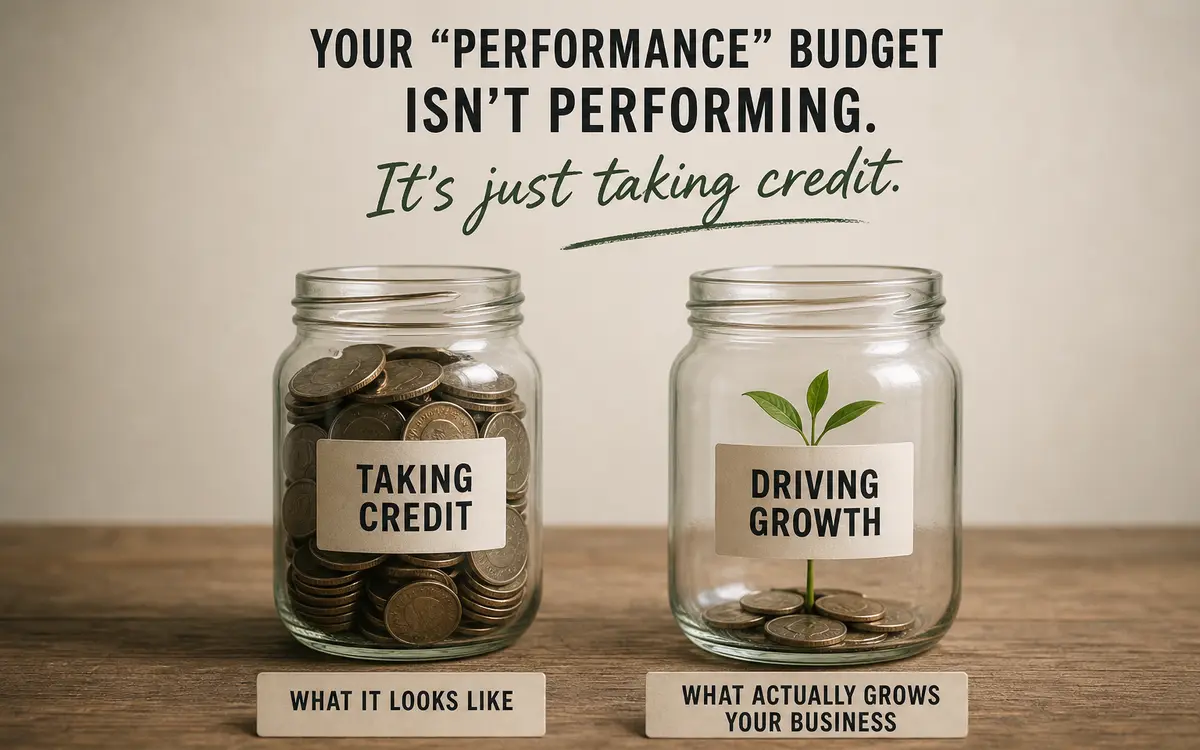
There’s a word that gets thrown around a lot in our world.
Performance.
Most brands think they know what it means. They run campaigns optimized for conversions. They watch ROAS. They scale what appears to be working. On paper, it all looks efficient. But here’s the uncomfortable truth. Most of that “performance” isn’t actually driving business performance. It’s taking credit for demand that already exists. And the more you scale it, the worse it quietly gets.
The first dollars always look the best
Every performance system starts the same way.
You capture the easy wins. People already searching. People already in market. People who have seen you before. People ready to convert. Those dollars look incredible. High ROAS. Clean dashboards. Everyone feels smart.
Then you spend the next dollar.
Now you are expanding audiences. Paying more to reach the same people. Retargeting harder. Competing for the same small pool of demand. This is where most brands lose visibility. Blended ROAS hides what is actually happening. The early wins prop up the average. The inefficient dollars stay buried. The system keeps getting funded.
Now apply that same problem to TV
This issue does not disappear in Connected TV. It gets worse because most “performance TV” is not actually TV. It’s open exchange video. Long-tail apps with little to no real viewership. Inventory that never reaches a living room. The same households being hit over and over again. It looks efficient.
Cheap CPMs. Easy scale. Clean reports.
But it is the same problem in a different form. You are not creating demand. You are recycling it. In some cases, you are paying for impressions that were never valuable to begin with.
Cheap does not mean efficient
A low CPM does not make you efficient. It just means you bought something cheap. What actually matters is much simpler.
- Did a real household see your ad?
- Did it run in a real viewing environment?
- Did it reach someone new?
- Did it create future demand?
Most platforms will not answer those questions clearly. The system is not designed to show you where the waste is. It is designed to keep spend flowing.
Brand is not the risk. Blind spend is
This is where the conversation usually goes sideways.
- Brand marketing feels risky.
- TV is seen as top of funnel.
- Performance is viewed as safer.
But that is not the real trade-off. The real question is whether your current dollars are actually incremental or if they are simply protecting a metric. A lot of “performance” spending targets existing customers.
It overpays for branded demand.
It double-counts conversions.
It pulls revenue forward with discounts.
It looks efficient in platform while quietly hurting margin.
That is not performance. That is misattribution.
What real performance actually looks like
At Bronco, we think about performance differently. Not platform performance. Business performance.
- That means reaching real households, not just devices.
- Showing up in real viewing environments, not background noise.
- Managing frequency with intention instead of saturating the same audience.
- Buying premium supply instead of whatever clears at the lowest cost.
- Measuring against outcomes that matter to the business, not just what a platform can report.
This applies across both linear and Connected TV. When done right, TV does not just capture demand. It creates it.
The shift most brands need to make
This is not about turning off performance channels. It is about understanding where they stop working. Most brands ask what their ROAS is. The better question is what the next dollar actually did. Did it create a new customer? Did it expand reach? Did it improve future efficiency? Did it grow demand? Or did it simply take credit for something that would have happened anyway?
Your growth budget is already there
Most brands do not need to go find new budget to invest in brand or TV. It’s already sitting inside their performance spend. It shows up as low incrementality, over-attributed conversions, frequency waste, misclassified inventory, and cheap impressions that do not move anything. That is the money holding growth back.
Final thought
Performance marketing is not broken. But the way most brands use it is. If you only fund what looks efficient inside a dashboard, you slowly starve the system that creates demand in the first place. And eventually, there is nothing left to capture.
If you are already running Connected TV or linear, we are happy to take a look. No pitch. No pressure. Just the truth about what is actually working and what is not.